
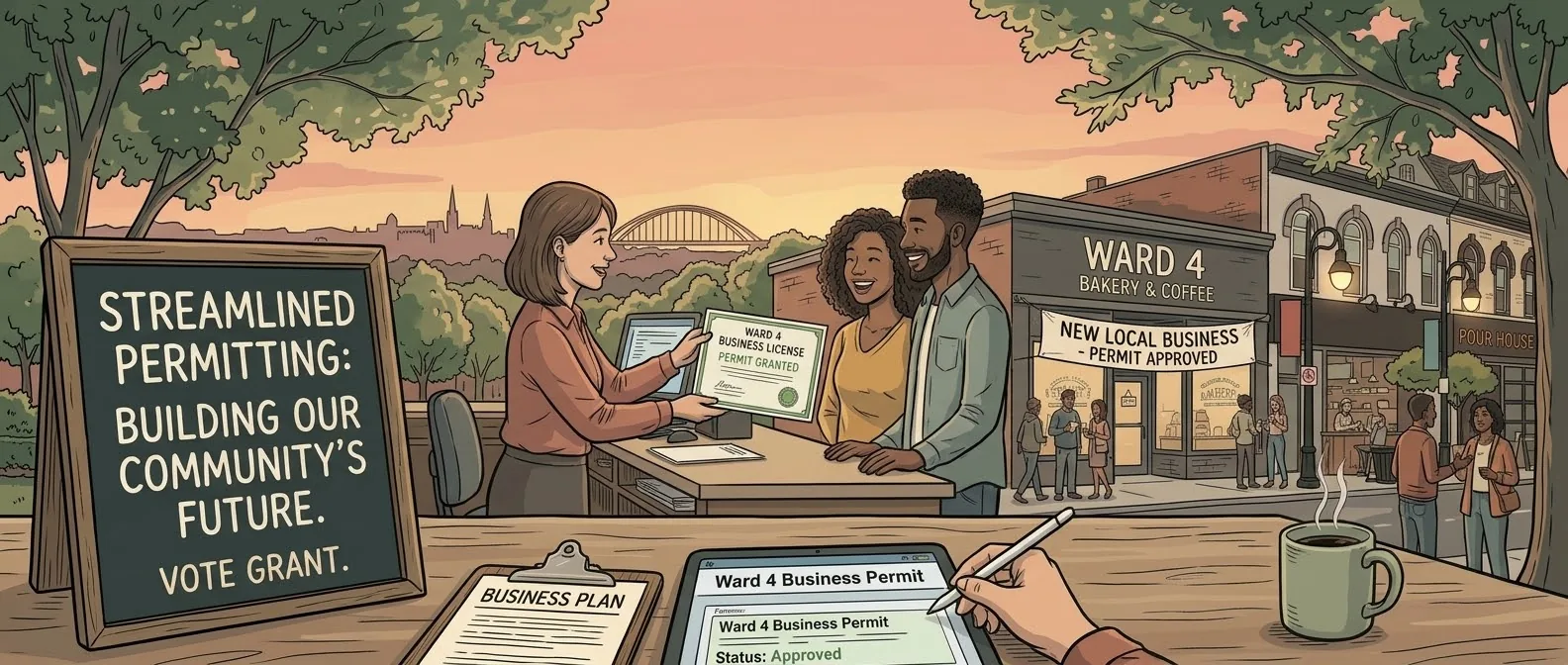
Business permitting
Opening or taking over a storefront in St. Catharines shouldn't mean inheriting a maze of surprise compliance costs. The rules are mostly provincial. The coordination is the City's — and it's fixable.
Last updated: October 6, 2026
The problem
Downtown storefronts sit empty for a reason that has nothing to do with demand. Taking one over can mean inheriting years of unknown compliance issues that surface only after the keys change hands: work a previous owner did without permits, fire-code requirements that apply the moment a building's use changes, gaps between what one City department signed off on and what another now requires.
Then the owner tries to get into compliance and runs into the second problem. Fire enforces the Fire Code, which applies to how a building is occupied. Building enforces the Building Code, which applies to how it's constructed. Those are two different provincial laws, applied by two different departments on two different timelines, and nobody at the City owns the job of reconciling them before the applicant is caught in the middle. Owners hire consultants to negotiate between their own city's departments. Projects stall for months. Sometimes they stop.
The third problem is the experience itself. Compliance is the owner's responsibility — that's true, and it's the law. But there's a difference between telling someone what they're responsible for and helping them get there. Right now the City does the first and leaves the second to the owner.
None of this is an argument against the rules. Fire and building codes exist because people died before they did. Front-line inspectors apply the law as written, and they should. The gap is process design, and process design is council's job.
What the City actually controls
The City's side
- Who coordinates a commercial applicant's file across Fire, Building, and Engineering
- Whether departments consult each other before a change-of-use permit issues
- What information the City provides to someone before they buy a commercial building
- Published service standards: timelines, status, and who to call
- The mandate of the St. Catharines Enterprise Centre, which the City co-funds
- How front-line staff are trained and how customer service is measured
- Whether a vacant commercial lot can be put to interim use, like parking, while it waits for redevelopment
Not the City's side
- The Ontario Building Code — provincial
- The Ontario Fire Code — provincial
- "Buyer beware": under Ontario law, the risk of a property's condition sits with the buyer, and the City can't change that
- Whether a specific permit is approved — that decision belongs to the Chief Building Official under provincial law, not to council or any councillor
What I'll do
- One coordinated answer. I'll move a motion directing staff to establish a single point of contact for commercial applicants, and to require cross-departmental consultation on every commercial change-of-use application so that fire and building requirements surface together, before the permit issues — not one at a time, after the owner has already spent the money. Where both departments need to see the same work, inspections get scheduled together: one appointment, one combined list. This is a reassignment of existing workflow, not a new hire, and it costs almost nothing.
- Know before you buy. The City already sells a zoning verification letter. I'll push to expand it into a proper pre-purchase compliance report — open permits, fire-retrofit status, zoning history — so a buyer can price problems in before closing instead of discovering them after. It uses information the City already holds, priced on cost recovery like the existing letter. No new permit fees, full stop.
- A path for interim use. An owner shouldn't need a full rezoning fight to put a vacant downtown lot to temporary use, like parking, while a project comes together. A clear, quick temporary-use process is a City process decision, and it belongs in the same coordinated system as everything else on this page. More on the Downtown page.
- A published service standard. Commercial applicants should be able to see the timeline, the status of their file, and the name of the person coordinating it. I'll push for that standard to be published and reported on, and for customer service to be measured and taken seriously as part of the job — because the City is, at bottom, a service organization, and the taxpayers are its customers.
- Navigation help that's already paid for. The St. Catharines Enterprise Centre is part of Ontario's Small Business Enterprise Centre network, co-funded by the Province and the City and free to businesses by design. Today it focuses on startups. I'll work to extend its mandate to permitting navigation for existing and incoming businesses. Other Ontario municipalities run free small-business permit navigation services; there's no reason St. Catharines can't.
- Build on what's improved. The City has made real improvements to how permits are handled in recent years, and staff deserve credit for that. This isn't about starting over. It's about the next step: making the departments work as one process for the people paying for it.
What a councillor can't do
A councillor can't change the Building Code or the Fire Code, can't override "buyer beware," and can't approve your permit — that authority sits with the Chief Building Official, and leaning on that decision is a Code of Conduct violation, not a favour. What a councillor can do is help a constituent whose file is stuck get the right senior people paying attention to it, and work at the council table to change how the City organizes itself to answer you. The first is service. The second is policy. I'll do both, and I won't pretend either one is the other.
Empty storefronts downtown and a fenced-off brownfield on Ontario Street are the same problem wearing different clothes: tools on the books, unused until pressure builds. Fix the process, and existing space comes back into use without a dollar of subsidy. That's the case on the GM site, and it's the case downtown.
St. Catharines has more tools than it uses. I'm running to make it use them.
This address reaches me, not a staffer: grant@granthigginson.ca
Sources
Everything on this page comes from public documents. If you want to check any of it:
- St. Catharines Enterprise Centre — Starter Company Plus (City of St. Catharines)
- Ontario — Small Business Enterprise Centre locations
- Small Business Centres Ontario — network overview
- BizPaL — Ontario municipal partners (St. Catharines listed)
- Government of Ontario — Planning Act, s. 39 (temporary use by-laws)
Last updated: October 6, 2026